

Interview by Nira Llarena, Press Writer and Creative.
No matter how much one tries to empathize, it's very difficult to understand what drives people like Alberto Hugo Rojas. Where does this obsession with delving into the most brutal and undesirable aspects of the human condition come from? And not in isolation, but as a way of life that shapes both his professional and his most intimate and personal aspects. If the world has an abhorrent flip side, it's war, a dirty business that stains and destroys everything in its path, chaining us to an eternal present of grotesque images like those Goya painted centuries ago in his series "The Disasters of War." Perhaps similarly to the Aragonese master, Rojas portrays the most earthly side of conflict: not the epic, but the silent suffering. And listening to him, one glimpses his conviction, the energy that fuels his passion: someone has to tell their story, these stories must be told because these people deserve peace, not oblivion.
With over two decades covering armed conflicts, this Lanzarote-born photojournalist in war zones has transformed his gaze into a bridge between fractured worlds. In 2024, his homeland recognized him as Lanzarote Native of the Year, an honor that recognizes not only his professional merit but also the courage with which he has embraced his profession and his commitment to promoting a culture of peace among young people.
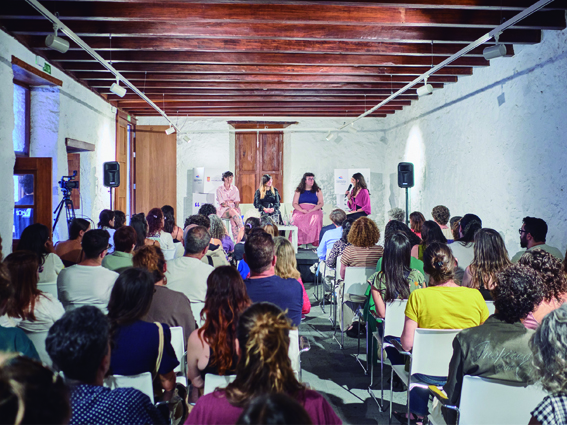
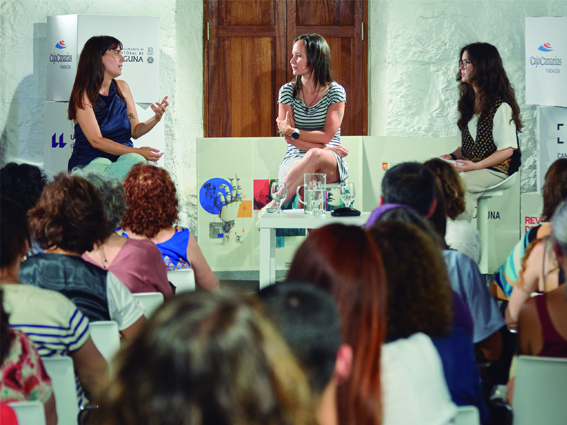
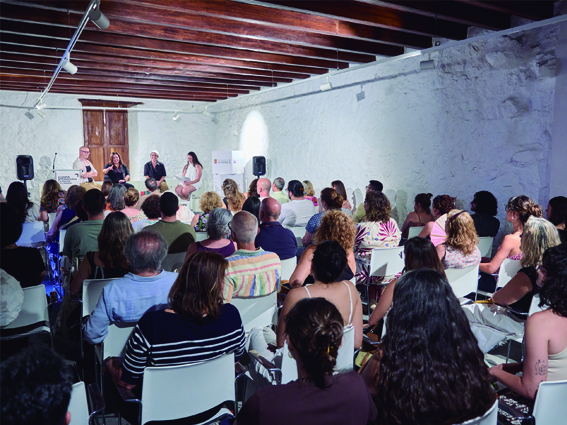
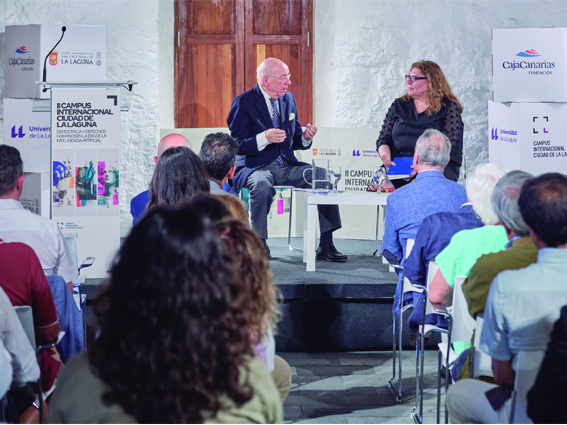
He will join us at this International Campus in La Laguna, participating in a roundtable discussion and curating an exhibition that can be visited at the CajaCanarias Cultural Center in Plaza del Adelantado, La Laguna.
In this interview, Rojas recounts his experiences on the ground with the honesty of someone who has learned that, sometimes, the bravest thing to do is simply to be there for those in need.
The first conflict you covered was that of Palestine and Israel. You traveled in 2002 and, very then, in 2003. More than 20 years have passed since then, how do you remember those first experiences?
Yes, I was very young and very scared. In 2002, I went to take photos and returned in 2003 because I needed to document it on video; I made something like a travelogue. It all seemed so overwhelming. When I first arrived in the area, we were talking about a historic moment: the Second Intifada, with Arafat still alive and Israel besieging Palestine for a month, even blockading the Muqata'a, the Palestinian administrative headquarters.
This went on for a whole month, and I was able to document it. Lately, I like to say that our work is a cautionary tale. At that time, we were already warning about where this conflict was headed.
And what sensations produces you to see the status of this conflict today?
Many other journalists and I witnessed the beginning of the construction of the Israeli separation wall on Palestinian soil, which has already been condemned by the International Court of Justice. Next came the illegal settlements, and even then, people were beginning to talk about apartheid. Then came the brutal offensive in Gaza in 2014, which was halted, in large part, precisely because of the presence of foreign media.
This situation has been coming to light for a long time, and it's not a "pro-Israeli" or "pro-Palestinian" or "pro-Ukrainian" perspective. No: it's a "pro-life" perspective.
Lately I like to say
that our work is
a warning job
We are living an overlap of conflicts, with one at the doors of Europe that does not seem to have a short -term solution. You have been in Ukraine on several occasions, the last recently. What impressions do you bring from these experiences?
On the one hand, it's striking how the conflict you cover determines whether you're a better or worse journalist. People sometimes say to me with pity, "Oh, you're covering the Middle East, but you were covering Ukraine," and my answer is always the same: I tell the story of the people, not a political one.
Furthermore, I think it's crucial that we continue to support the Ukrainian people. I hope I'm wrong, but I believe this conflict won't have an easy solution. Ukrainian society is already very weary. Unlike the first year, when people believed Ukraine would win, in my last assignment I could see that weariness firsthand. They're sacrificing an entire generation of young men and women. The age for forced conscription has been lowered to 25, and it's possible it will be lowered again. And many people no longer want to fight; so many are leaving the country.
Through my organization, Peace in Construction, I advocate for the understanding that we cannot let Ukraine fall. And it's not a question of sending more weapons, but rather of understanding that if Ukraine falls, any other European country could follow, and what we're talking about are fundamental human rights and freedoms.
So, at this point, I think it's very important that we are clear about the fundamental values of the European Union: human dignity, freedom, democracy, equality, the rule of law, and human rights. We cannot forget them, and we must continue to carry out important educational work.
Let's talk about the profession of the war journalist. I find it contradictory that professionals like you are usually admired and publicly recognized but in practice they work in very precarious conditions and with little protection. I remember, for example, José Couto Oa Julio Anguita Parrado, sadly deceased. How would you describe the current context for war journalists?
Unfortunately, the work we do is highlighted, but we have no job security. The precariousness of our work has only worsened in recent years. Spanish media outlets pay a pittance for a photograph or an article. As a freelancer, the situation is dire. For example, I get my bulletproof vest and helmet through Reporters Without Borders by putting up a deposit. Many of us also go into debt: projects operate on loans, and when you get paid, you pay them off and move on. And, as a freelancer, it's very difficult to obtain press permits. For example, to cover the Palestinian conflict, Israel makes it extremely difficult. Or in Ukraine, they require a letter of support from a media outlet.
Furthermore, our work history, in terms of social security contributions, is practically nonexistent. Retirement is going to be very complicated.
In my case, I'm publishing less and less, not only because of this unfair compensation, but also because of how my work is being used. Many times, my photos have been published out of context and used to spread disinformation.
We take on a huge risk that, when you get killed, is highly recognized, but while we are performing our profession we are not protected.

The true heroicity is that of the people who play life; I can give you hundreds of examples of normal people who in places of conflict put their lives at risk of helping others
For a few years we see how armed conflicts are not just counted by journalists. The generalized use of mobile phones allows the protagonists to tell what happens in the first person and practically live. What do you think about this phenomenon?
It's a double-edged sword: on the one hand, we see a lot of things in real time that aren't verified but are used, and on the other hand, it also gives rise to the damned disinformation and propaganda.
We're in a time of tremendous noise, where many people are questioning reality itself. I remember the video of a guy, with a lot of followers on social media, who said that the war in Ukraine was staged and didn't exist. The use of mobile phones allows us to see things live that we didn't see before, things that were filtered through television channels. And at the same time, the media is starting to use material that isn't of sufficient quality, when, not so long ago, we were required to have the highest quality. Now anything goes. The uncontrolled use of social media has also contributed to the disrepute of our profession. Many photos are taken out of context or used without permission, even by "serious media outlets."
Because of all this confusion, I think the role of filters and telling the truth through the eyes of those who experience it is important. For example, in the educational projects we develop in the Canary Islands, I show the story of a Ukrainian girl named Regina, whom we have followed for the last three years of her life. This allows young people to see the reality of what war is like for someone like them, beyond the fleeting nature of an Instagram reel.
Continuing with this, speaking of this current of individualism so strong that we live. Would you say that current society is aware of its vulnerability to a possible armed conflict or humanitarian crisis?
That warning work that told you that we must do journalists also in this line. For example, with climatic emergency. Sometimes I think that any day of these will go out to say: "We are wrong with the calculations and it will not be in five years, but tomorrow, because we have done so bad that we have already reached the point of no return." And the same will always happen, the richest people can pay for the most basic things but the majority of the population, no. I have seen it in wars. True solidarity is based on human rights. And the management of crisis situations must come from institutions, not from international solidarity. I am very critical of, for example, food banks. You, City Hall, you are the one who has to feed, with dignity, to your population that cannot. You, entrepreneurs, have to get involved with your society in crisis situations. In Ukraine, the public and the private are working in coordination after the bombings, it is a great example. There is one thing that is curious in our society: in the media here it has become people who simply help "heroes." We have forgotten the basics of social relations, being a good neighbor. The true heroicity is that of the people who play life; I can give you hundreds of examples of normal people who in places of conflict put their lives at risk of helping others.
The “Entangled with Human Rights” project
has reached more than 20,000 students.
You have told me several times about the importance of pedagogy during the interview. Tell us a little about the NGO “Paz under construction” that has been working for years in the educational centers of the Canary Islands.
It all began after our initial fieldwork. It was then that I realized we had to invest in education as a path to peace. We had worked in conflict zones and wanted that experience to transform teachers and young people into human rights defenders. Over time, the project grew so much that in 2020 we became an NGO. What we do doesn't stay in the classroom: it extends to families, neighborhoods, and even reaches other countries. We provide support, raise awareness, and demand the fulfillment of rights, because every refugee, every missing child, represents a life that deserves a future.
The project developed in recent years is called "Entangled with Human Rights" and has been made possible thanks to the support of the Canary Islands Government's Department of Youth and the collaboration of the Orfeón La Paz choir.
The idea is for students to understand, embrace, and defend the Universal Declaration of Human Rights, starting with what they see every day on social media, television, or the internet. We use the calendar of world days (International Day of Peace, International Day Against Violence, etc.) to connect, through thematic photographs, with the United Nations international treaties about which there is a great deal of ignorance. It's crucial to remember the foundations of coexistence in Europe, the framework of Human Rights.
Over these three years, from 2021 to 2024, we visited 230 schools, directly involving more than 20,000 students and delivering 462 talks.
This project, which originated in the Canary Islands, has become a benchmark. And best of all, the work done by the students themselves remains available to the entire educational community. In addition to this project, we have carried out many others previously, and I can say that we have given more than a thousand talks, to give you an idea.
I trust that these boys and girls, who are now more aware of the importance of respecting and defending the rights of all humanity, will one day become the mayor of one of our municipalities, or the president of our Island Councils, or the president of the Government of the Canary Islands. We will continue working to make that happen.
Despite the hard of the conversation, we say goodbye with laughter with the promise to meet soon at the inauguration of his exhibition in La Laguna. While reviewing the notes I have taken, I keep thinking about that idea that Alberto repeats: that his work, that of so many other war journalists, is a warning. What happens in those other worlds, on those fronts that we sometimes feel distant, it soon splashed. Wars are never alien. Listening to those who have lived them closely becomes an act of responsibility. Do not forget that we will have the opportunity to listen to Alberto and other war journalists at the round table that will be held on July 29 at the Santo Domingo convent or follow her by streaming.