

The Second Literary Meeting of Women Writers of the Canary Islands reflects on how memory, identity and experience transform the territory into a literary space.
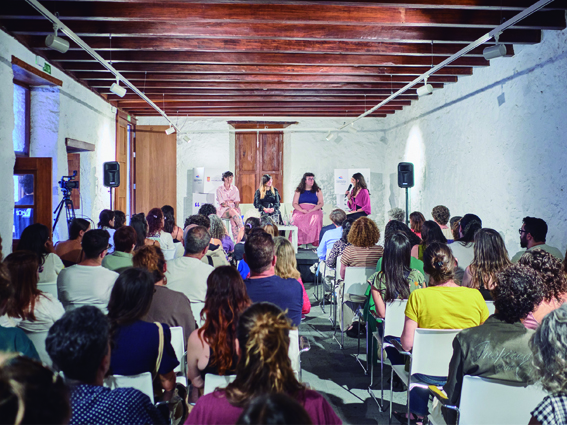
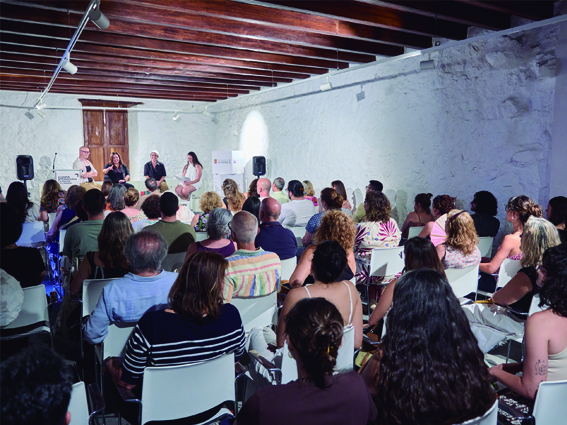
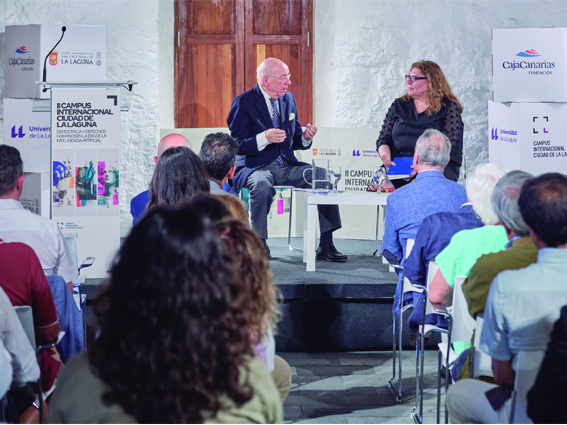
The 2nd International Campus of La Laguna hosted the second session of the Literary Encounters of Canary Islands Women Writers this Tuesday at Casa Anchieta. This session, entitled "Literature and Territory," featured poet, teacher, and researcher Acerina Cruz and writer and illustrator Lana Corujo, in conversation with philologist Beatriz Ortiz, leading a dialogue and reflection on the relationship between literary creation, territory, and identity.
The event brought together diverse perspectives on the influence of the Canary Islands landscape on creative processes and the construction of narratives linked to identity, memory, and a sense of belonging. Throughout the discussion, the authors explored how territory transcends its physical dimension to become a narrative element capable of shaping how we see, remember, and tell stories about the world.
Writing from the Land:
During the meeting, both writers agreed on the importance of a literature born from experience and lived experience. Acerina Cruz defended the difference between writing about a place and writing from it. “I’ve written about places I’ve visited as a spectator, but writing from a land means writing from the place where your identity is built,” she explained.
The author recalled growing up in Maspalomas and asserted that even spaces linked to tourism form part of personal memory. “Each of those corners is associated with my childhood memories. They cease to be empty spaces because they are full of memory and nostalgia,” she stated.
Lana Corujo, for her part, affirmed that she understands writing as “an excavation,” a process of searching in which words allow her to approach the questions that drive her creation.
The writer explained that her first landscape wasn't the volcanoes or the sea of Lanzarote, but rather her familiar surroundings. “Many times the Canary Islands appear in my books more as the setting where the stories take place than as an aesthetic image. The absence of a specific landscape also opens up the possibility of creating other landscapes, and I think that's where an important part of my writing originates,” she concluded.
The dialogue allowed for reflection on the many ways in which the Canary Islands are represented in contemporary literature, highlighting the richness and complexity of island experiences in contrast to simplified or stereotypical views. From different genres and backgrounds, both writers emphasized literature's capacity to transform the territory into a symbolic space from which to address universal issues related to memory, emotions, displacement, and the construction of identity.
The Literary Encounters of Women Writers from the Canary Islands are part of the cultural program of the 2nd International Campus of the City of La Laguna and are being held in conjunction with the exhibition "Constellation of Women Writers from the Canary Islands," located in the Casa Anchieta. Both initiatives contribute to highlighting the careers and current work of authors from the archipelago, creating spaces for dialogue between writers, specialists, and the public.
The series will conclude with the event "Literature and Diversity," which will bring together writers Aida González Rossi, Alexis Erbez Díez, and Ainara Oleaga, moderated by philologist Celia Lorenzo. The conversation, to be held on Tuesday, July 21, at 7:00 p.m., will address the various ways in which diversity is represented in contemporary literature and the role of dissenting voices in the construction of new cultural imaginaries.
Those interested can register and find more information through the website www.campusinternacionalciudaddelalaguna.es.